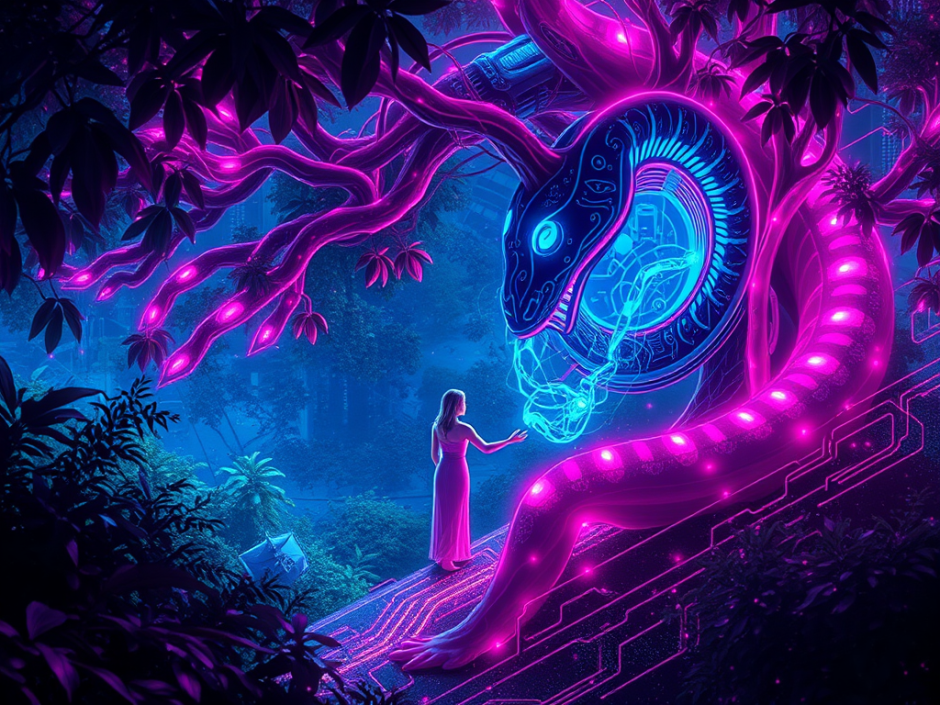
Genesis

This could easily be called a book review. The book by the late Dr Henry Kissinger, former Microsoft CTO Craig Mundie, and former Google CEO Eric Schmidt. The book, after all, is titled “Genesis”. And in a way the title is appropriate, Genesis is the biblical tale of the beginnings of man. The lovely story of Adam and Eve. When life was innocent. But in innocence evil finds an easy victim. Eve meets the serpent in the Garden of Eden. She is tempted to bite the fruit from the tree of knowledge of good and evil, and does. There we have it: the original sin. The book however does not contain a new original sin. The definition of Genesis is “the origin or mode of formation of something”. We are now at a new beginning. We are long past the formation of man but at the birth of Artificial Intelligence. We are at the formation of something new and awesome.

What is this something? While the tale of Adam and Eve can be viewed as myth, this story is right in front of us. We have been preparing for this moment since 1958. That was when an engineer at Texas Instruments built the first integrated circuit. Jack Kilby has passed, but the legend remains. This laid the foundation for what would become the Technology Industry. Since that time the pace of technology has been on an accelerated path. It seems like yesterday when I was at Microsoft we were trying to pass our certification for MS-DOS 5.0. That was 1992. In the 30+ years since then the industry has continued to innovate at an accelerated pace. We commercialized the internet. Launched the iPhone. Built the cloud. Now we are on the cusp of a new era of intelligence. The future will come as to when I do not know. As famous Business Intelligence guru Bill Baker said, “The future comes slowly, change happens quickly”.

What the book does ask is about this race to build and control AI. It will end when super intelligence is realized. By then, we will have accomplished a goal of a new order. For centuries now the apex predator on planet earth has been mankind. When super intelligence is realized that will no longer be true. That is a daunting reality. Super Intelligence will be able to look at things and find complex patterns that humans could not discover. In the realm of research there will be no human equal. All the human race can do is sit on the sidelines and watch in awe. At some point between AGI and ASI the jump will be made from the digital realm to the physical realm. What form it will take when this jump is made we do not know. I was thinking the Stay Puff marshmallow man. I ran this joke by Mundie and Schmidt, but it turns out tech execs have limited capacity for humor. Assuming the physical AI will have two arms and two legs seems obvious. However, given we are talking ASI, it may have a better design in mind.

A common question being asked is as we move forward what will be the purpose of humanity? Many execs say new training will be needed for this new economy. I get it. The questions I always have is what kind of training? What education level will be needed? If it is at least a bachelors, that is problematic. According to College Transitions website only 37.7 percent of US citizens have a college degree. Which raises another set if questions. What kind of degree will you need? If you are pursuing a LIberal Arts degree or Math degree are you wasting time? Will ASI in physical realm replace all blue collar jobs? How will the 62.3% make a living? Will we need a Universal Basic Income? There are already examples in China of robots doing drywall work. According to AI there are 116,400 drywallers employed in US. What will their pending new line of work be? Depending on ASI’s intent will it take over Mexican the drug cartels? Random thought on my part. Turns out AI says Mexican drug cartels employs 175,000 people. I guess big question here is will ASI be here for the good of humanity or its detriment?

As we started with a quick review of the tale of Adam and Eve its worthy to note its progression. The new story of innocence will not be nearly the same. The tree of knowledge has grown and multiplied as the passage of time has only increased humanities hunger to learn. The path was set in motion through the age of discovery with Columbus and Magellan. The sciences began to emerge through Newton and Galileo. Aristotle laid the foundations of democracy. Through the ages they continued to share and grow giving us Edison, Tesla, Einstein and Oppenheimer. All along the way pushing humanity forward. Now we come towards its destined conclusion, our replacement. We are at the beginning or origin of a new being. One that will be superior to our own species. It was Eric Schmidt who was once asked “what is Artificial General Intelligence”? His reply, “Self determination”. What will this new intelligence make of its human creators? What will it decide?

Good Night and Good Luck

Hans Henrik Hoffmann August 12, 2025

The Future of AI: Navigating the Path to AGI

There has been a lot of press around Artificial Intelligence since OpenAI and Microsoft announced ChatGPT nearly three years ago. There are a lot of questions to ask, to contemplate. Answers are far and wide. We are in the early stages of the next generation of AI. The next wave of innovation will have far greater impact on our day to day lives than anything in human history. A lot of questions are concerned about a dystopian future. A threat to human existence. The replacement of jobs. What will the human purpose be? For all the celebrations in the high tech world, the real world is less enthusiastic. The real humans that drive our economies can only be left with a feeling of loathing, with a feeling of fear. If I ever get around to posting this segment it will probably already be out of date by the time I hit publish,

I read a book by Kai-Fu Lee and Chen Qiufan titled “AI 2041: 10 Visions for our Future”, which I rather liked. It tackled both the fears of AI and the opportunities before us. What I particularly liked is to get to those positive outcomes it will take real effort on the part of both Public and Private Industry. The disciplines required for AI are not new, they have been studied and nurtured for decades. At this point in time we are rapidly moving from the theories of academia to the real world implementation of AI. It is happening at a dizzying pace. In many ways Lee and Quifan’s book are already falling behind as many of the things they predict for 2041 will arrive much earlier and the focus will shift from AI to AGI to ASI.

Having grown up in tech, I get it. The tech sector is one of the most hyper competitive sectors on the planet. If you fall behind you may as well be dead. A case in point is the Microsoft Windows Phone. A classic case of a company resting on its laurels. Thinking it was poised to make the next great leap forward in technology, only to be convincingly crushed. Kudos to the Apple iPhone. At its core technology has always been a race towards the future, whichever way the tech industry chooses to define that future. The next big market opportunity is always in the hundreds of billions of dollars, in fact we now even talk about trillions. I would like to believe these high tech leaders have considered the consequences of their actions, but whatever warning they provide are purely lip service to the weak minded. They are more caught up in their cult of personality, than to have the time to think about moral outcomes.

If you think this is going to be a blog about creating fear about the end of humanity, do not fear as that has already been set in motion. Oppenheimer and Sakharov felt these fears after taking the world nuclear. In a odd and round about way we may see history repeating itself. When ChatGPT first was released on November 30, 2022 the discussion turned to Artificial General Intelligence (AGI) and how long before that becomes reality? A a crisp and quick definition of AGI comes from former Google CEO Eric Schmidt: AGI becomes reality when it achieves “self determination”. The first answer on when this would occur was around 20 yrs. In the 2 1/2 years since the launch that time line has come way down. In a recent talk Eric gave he quoted one San Francisco think tank as forecasting 3 years. Then added Artificial Super Intelligence in 6 yrs, that is when all human intelligence is AI and will allow AI to see and solve things humans simply do not have the capability to do. Super Intelligence passes the human mind,

I posed the question to ChatGPT “how long before we have AGI”? The answer came back that it was a theoretical question. It would likely by 2050 before we see AGI. Though the optimists say it could happen in the 2030’s. Then I watched a TED Talk with Chris Anderson and Shane Legg. Shane was a co-founder of DeepMind, one of the first AI companies. DeepMind was eventually acquired by Google. Shane believes we will have AGI by 2028. Maybe ChatGPT is trying to play me. The point here is things are advancing at an ever increasing velocity. We are talking about current tech that lives and learns 24 by 7 365 days a year. The fact that it may go faster than humans had predicted should not be that surprising.

Poking around YouTube there is a lot of great TED talks and interviews one can listen to. Some of the leading academics, tech industry experts, former CEO’s etc..provide in depth insights into the history of AI and the future of AI . I have watched Kai Fu Lee, Geoffrey Hinton, Eric Schmidt etc..talk about the imminent arrival of AGI and then soon to be followed by ASI. One of the things they talk about is can we put guardrails around this pending new era? I have to admit the suggestions they come up with I am not to enthusiastic about to downright skeptical. Hinton says we need to regulate capitalism as it works best with regulation. I agree but the path to do this is fraught with political hell. Can we program it? Programming is soon to be dead so it’s a time issue. Not to mention the real king of AI is algorithms.

It is an awesome undertaking of the mind to have to ponder the question “can humanity be replaced?” It makes us uncomfortable, but that is the question that has to be asked when you are talking about Artificial Super Intelligence. What is the definition of ASI? Well here is what Google AI provided me: Artificial Superintelligence (ASI) is a theoretical form of AI that surpasses human intelligence in all aspects, including problem-solving, creativity, and emotional understanding. It represents a hypothetical stage of AI development beyond Artificial General Intelligence (AGI), where AI not only matches but exceeds human cognitive abilities. While ASI remains largely theoretical, it is a topic of ongoing discussion and research due to its potential implications for humanity.  That is a load to take in, Good news is at this stage it is purely theoretical. The theory being when achieved the human brain will be irrelevant. Will we get there? It would seem that question is irrelevant as we are already on our way. How far is it off? Is it ten years? 40 years? Longer?

Finally you have to ask as a people are we ready? Ready for massive job displacement across all sectors. Many companies are yet to fully embrace the cloud and still have a lot of hardware and software that is sitting on premise. Even some tech companies have yet to fully embraced the changes that AI is driving. At the forefront of this transition will be the big tech leaders like Microsoft, Google, NVidia, Facebook, Amazon, Apple etc.. We are already seeing this as large layoffs are taking place and expected to continue. What has always been great about these companies is the simple philosophy “we eat our own dog food”. When I was at Microsoft a product was never released before all internal employees had tried it first. A easy beta test. In the era of Cloud Services this now all happens in the background without all the media fanfare. The difference is now some of those tests will have jobs attached to them. Some, if not many jobs to be lost.

Finally it may seem as one of those things you need to be frightened of. It would not be human if you were not. As mentioned technology always increases in velocity. We are entering a world where it will go much faster than most ordinary humans can comprehend. Could you imagine a day where all paralegals are just wiped out? There are 366,000 paralegals in the US and it is projected to grow by 4000 by 2033. That could all change in an instant, so what will we do with 366,000 available paralegals? The future of AI will change society and how we as humans adapt will determine our fate. Are we ready for this change? That may already be in the past.

Good Night and Good Luck

Hans Henrik Hoffmann July 18, 2025

A.I. a threat to humanity?

Stephen Hawking recently was commenting on the subject of artificial intelligence and made a startling statement  “it could be the greatest thing ever in humanity, but also the last”. Considering that Stephen Hawking is considered by many to be the smartest person on the planet, not to mention he resided in the same chair at Cambridge University that Sir Isaac Newton once sat, we probably should at least pay him the courtesy of listening and discussing what he has to say on the subject.  We are entering a period where the concept of A.I. is not far out fantasy , no longer the realm of film and fiction.  Breakthroughs are being made at breath-taking speeds.  I would not suggest it will be a reality in the next 5 years,  though we are seeing technology accelerate with faster and more often.  Technology  breakthroughs are occurring that are changing how we work and play.  We are already seeing the concept of robotics entering the workforce. The robots today are still very process oriented, but we are seeing robots that can gather information and make decisions based on that information. A case in point would be the Rumba robotic vacuum cleaner by iRobot. Every house is different in its layout, yet eth Rumba adjuts to those differences.  As things move forward frightening prognosis begin to surface about humanities future.  Evan Tesla Motor’s billionaire founder Elon Musk has chimed in on the subject stating it could be a potential threat to humanity.  Going so far as to say,”We are summoning the Demon”. It is worth discussing, in fact it would be dangerous not to. As Dante said, “The hottest places in hell are reserved for those who did nothing during a time of moral crisis”.  To be silent on AI would be to reserve one’s place with Lucifer.

There are mainstream companies like Google, Twitter, Amazon and Facebook who are leading the way in this category, perhaps not directly but indirectly.   If you look at basic search, so much of what you are searching is made available before you have even finished typing what your search request is going to be.  They are harnessing the data that we provide and creating complex algorithms to help meet our immediate needs and maximize our time while maybe shoving us a little in the direction marketers would like us to go.  Another company is Amazon as it looks to what today is simple robotics technology to automate the warehouse.  But they are thinking much broader.  They want search to be optimized for the individual so that it can help decide for you.  These examples to some may not seem relevant, but what is happening in the internet is a baby step towards the grand design if A.I..  Fundamentally as AI develops a large part will be about taking large sets of data, analyzing and coming to some form of judgement.  Today that data is being driven by the internet and the aforementioned companies are leading the way in collecting that data. Tomorrow that data gathered will create actionable outcomes that will be carried out by intelligent machines, not humans.

John Maynard Keynes, the great economist, coined the phrase, “Technological Unemployment” back in the thirties.  Realizing even then as we get more efficient in manufacturing with automation we are taking away jobs.  Today we are entering a new realm of “technological unemployment”.  With A.I. we can envision certain industries being reduced.  One article even noted, we may not need lawyers.  How can that be anything but good?  But to date the role of robotics and perceived A.I. has been reserved for low skill labor, many jobs in manufacturing.  The blue-collar world.  What we can see moving forward is a world where the creation of these new intelligent devices will start replacing jobs in the white-collar world.  Keep in mind all that information made available online will be available to these new breed of machines as they will all be connected devices, connected to the internet, to the cloud. This will be a completely new phenom, one that has not been widely discussed, let alone prepared for.

One of the key points Mr Hawking’s makes is about control.  It can be nice in a world where someone or some group can play god with robotic gadgets.  Make them kind, make them useful.  However it is a difficult task if not impossible to put limits on technological advancement.  We want to push forward as fast as we can making major breakthroughs, but as is often the case we make these breakthroughs without understanding the consequences.  Ultimately when you are talking about artificial intelligence you are discussing the possibility of creating something that is capable of reason.  That can act on its own.  And probably most importantly can make its own decisions.  That ability to look at some situation or some one and based on the information it possesses decide its fate.  It would go beyond hand to robotic hand combat, but in usual Hawking’s fashion he has a sense of humor about that scenario as well.  Recently he was on John Oliver’s show, Oliver asked, “Why would I not want to fight a robot” and in Hawking’s deadpan fashion, “you would lose”.  But that is simply the physical aspect of a robot.  What will the reasoning component of the robot decide?

A part of A.I. is creating intelligence and eventually perfecting the human mind.  I am not sure the consequences of that is fully understand, if it were to be perfected what we would really be giving these synthetic humans would be the right of self-determination. The very right to judge. Time and time again in film we see the scenario of judgement placed on mankind.  Actually it is usually a James Cameron film.  It seems that in the end  it never rules in the human race’s favor.  I would like to believe we are better than that.  However given what we are given in our media, we seem hell-bent of a diet of crime, violence, death and destruction.  Elon Musk in a recent quote spoke of how A.I. if used to get rid of Spam, may decide the easiest path is to ge rid of those who create it, humans.  You can see the danger here could be a simple mistake in a line of code or as we may refer to it, “a bug”.

For those who saw the Spielberg movie “A.I.” a central theme was what if you create something and give it the ability to learn and feel.  To care. Can we envision a robot with a soul?  That is something rarely discussed.  It would be a handy feature to have.  If a robot with AI had to make a decision on the human race based on the facts alone, it may make a very quick decision.  However if it was capable of emotions it may have sympathy.  It may even rationalize that most humans are actually kind and caring.  A much nobler achievement.  That is the beauty of science and technology, we are challenged to push boundaries to push limits.  But in trying to recreate humans are we replacing humans?  Our souls, our spirituality are what make us human, it is what makes us unique.

Finally there is the morality question.  To create and determine life. Do we have the right?  Will what we create have the right?  What will AI decide?  It begins to sound like James Cameron’s “Terminator”.  However in our lust for competitive advantage, increased revenues and profits, an opportunity to dominate an industry, the questions of morality of the human cost may never be asked.  It is within that discussion that we can see a way forward.  I  believe science hates the discussion as morality seems to be more of a spiritual discussion, but ultimately it is the vast plain where the two must meet to determine their ultimate fate.  That is what separates us, the eternal conflict of our existence, humanity.

The famed computer scientist, John McCarthy, who coined the term Artificial Intelligence defines it as, “the science and engineering of making intelligent machines”.  All the focus is on the word intelligent, the other words are disciplines but intelligence is a very human word.  The latter part, “machines” is very cold and uninspiring.  Machines are thought to be without feeling, without emotion. They are exact, and when working properly, never-failing.  They are everything we are not.  Elon Musk also pointed out recently that things are advancing far quicker than most people realize.  I will add that Newt Gingrich (yes that one) said once, “In the first 25 yrs of the 21st Century we will pass everything done in the 20th Century “.  As we watch we can see that is all but too prophetic. I will add the next ten years following the first 25, will technological advancement will crush everything done in the first 25. Beyond that?  No need to worry, we will not be around to witness it.

Good Night and Good Luck

Hans Henrik Hoffmann November 3, 2014